From strategic alignment to organizational change: operationalizing the Blueprint at the Dementia Australia Research Foundation
Dementia is Australia's leading cause of death, creating an urgent need to support research with the greatest potential for real-world impact. Government funding is increasingly competitive, translation pathways are fragmented and talented researchers are leaving the field as funding and opportunities dry up.
As Australia’s largest philanthropic funder of dementia research, Dementia Australia Research Foundation has invested more than $41 million in over 400 projects since 2000. This includes funding for early- and mid-career researchers doing innovative, high-potential work that can fall outside traditional government funding streams.
So, we asked ourselves, what else could we do?
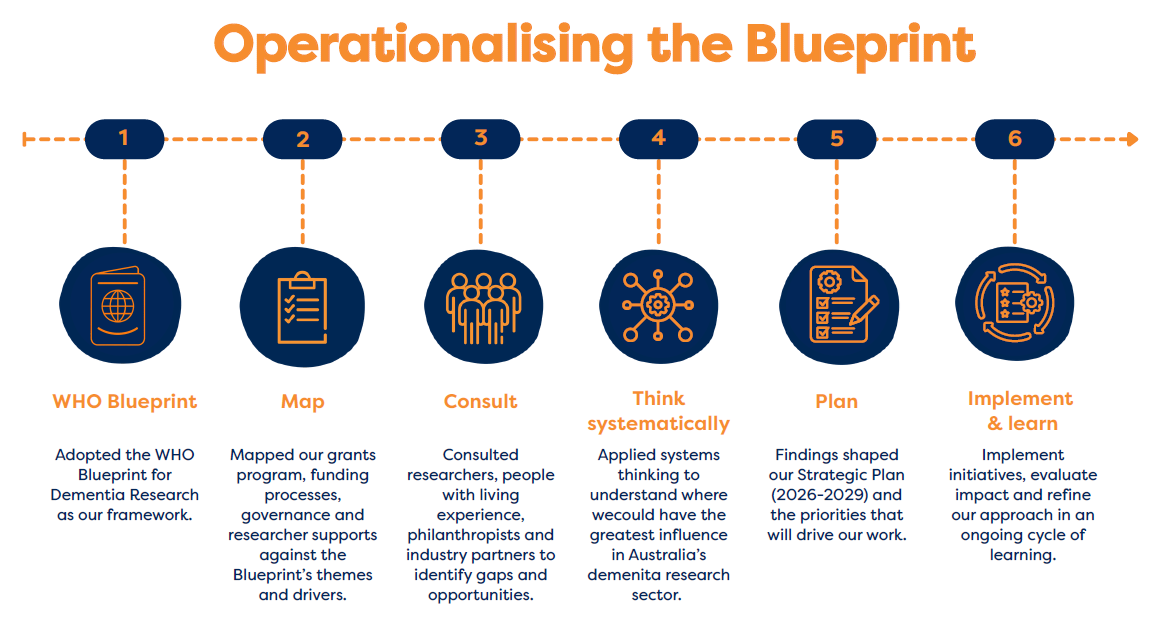
That question led us to review our grants program in the context of the WHO Blueprint for Dementia Research.
Then we asked a more important question: how could the Blueprint shape our future and the future of dementia research in Australia?
We mapped our grants program, funding structure, governance and researcher supports against the Blueprint's drivers and themes to identify existing alignment, gaps and opportunities. We then consulted researchers, people with lived experience, philanthropists and industry partners about their pain points and how we could address them.
Systems thinking shifted our focus from funding individual projects to considering how we could support the wider, interconnected dementia research sector. It became clear that our greatest opportunity to create impact extended beyond funding research.
There was an opportunity (and a need) to invest in researchers more, so talented people remain in the field. This included:
- Connecting researchers with policy, industry and implementation partners to accelerate translation
- Raising researchers’ profiles
- Encouraging and facilitating collaboration amongst researchers instead of competition
- Strengthening researchers capability to meaningfully involve people with lived experience of dementia in their work
What began as a strategic alignment exercise became the foundation of our Strategic Plan (2026–2029). Funding excellent research remains at the heart of what we do, but we now see it as the beginning of our contribution, not the end.
Over the next three years, we will implement changes across multiple Blueprint drivers. Some of these include:
- Mandatory training on meaningful engagement of people with lived experience in research
- New diversity and equity measures
- Including targeted grants for culturally and linguistically diverse and First Nations researchers
- Supporting knowledge translation and commercialisation
- Additional professional development support
- Access to data from Australia's longest-running study of health and ageing
- Annual pulse checks to identify progress, gaps and priorities across the dementia research sector
Evaluation is the next step. We plan to assess how Blueprint strategic alignment influences our organisational practice, researcher capability, knowledge translation and the broader research system. By monitoring implementation over time, we hope to refine our approach and share practical insights with other research funders looking to align with the WHO Blueprint for Dementia Research.
For more information visit https://www.dementia.org.au/dementia-australia-research-foundation