Virtual webinar series on dementia care
From October 2025 to March 2026, the World Health Organization’s (WHO) Regional Office for the Eastern Mediterranean and WHO headquarters, in collaboration with the WHO Collaborating Centre for Healthy Ageing and Dementia in Doha, Qatar, organized a series of monthly virtual webinars addressing the seven action areas of the Global Action Plan on The Public Health Response to Dementia 2017-2031. The webinars were facilitated by leading global and regional experts. Topics covered throughout the series included:
- Memory services in Qatar – The caring futuristic model, with subsequent sessions addressing improving access to diagnosis and management of dementia in primary care settings;
- New biomarkers and techniques;
- Novel disease-modifying and symptomatic treatments for dementia, including current evidence and future directions;
- Support for family caregivers of people with dementia using iSupport and the e-DiVA Virtual Assistant;
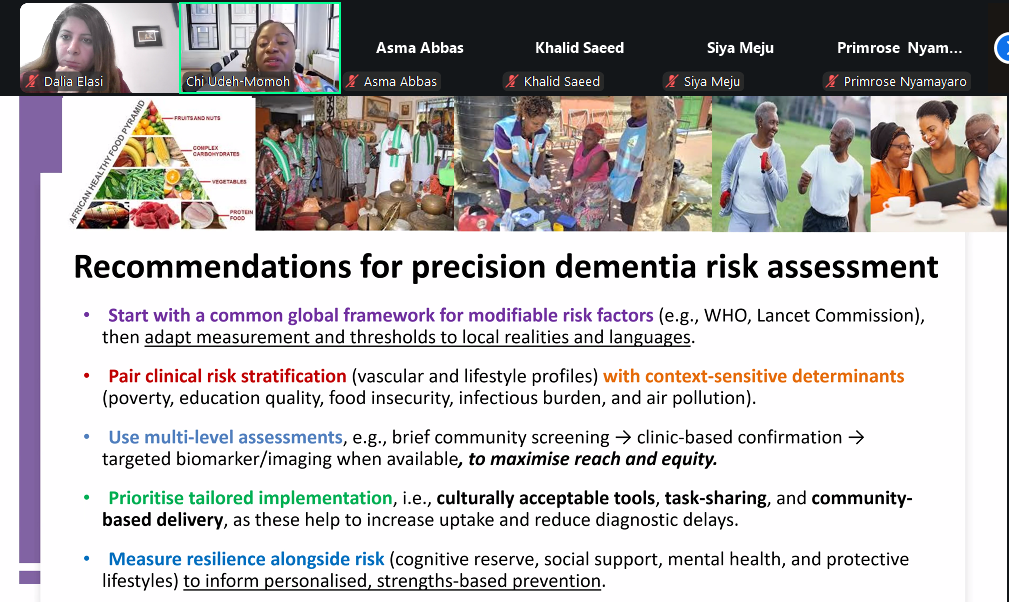
- Approaches and methods for evaluating dementia risk -strategies for operationalizing risk reduction through targeting modifiable risk factors;
- Integration of dementia care in emergencies and humanitarian crises;
- Dementia monitoring across the Region using the Global Dementia Observatory (GDO).
The webinars were attended by more than 417 global and regional experts, clinicians, civil society, and government representatives.
The key take-home messages from the series include:
- Scalable models of care are emerging. Qatar’s memory clinic model demonstrates that integrated memory services can significantly improve access to timely diagnosis, care, and crisis management, offering a model for potential replication in the Region.
- Advances in diagnostics and treatment are accelerating. Blood-based biomarkers and disease-modifying therapies are creating new opportunities for earlier, more accurate diagnosis and improved clinical outcomes. Countries will need to prepare systems, pathways, and workforce capacity to translate these innovations into practice.
- Family caregivers remain the backbone of dementia care. Their psychological, social, and economic burden is significant. Innovative solutions such as WHO’s iSupport programme show promise in delivering personalized, scalable support with potential for scaling up.
- Monitoring systems are critical for driving progress. GDO data indicates encouraging progress toward global targets, but persistent gaps remain –particularly in developing national dementia research plans, reporting diagnostic rates, and implementing risk-reduction campaigns.
- Dementia risk is shaped by local determinants. Effective prevention requires adapting global evidence to local cultural, social, and health-system realities, and embedding dementia risk-reducing within broader mental health and NCD strategies.
- Dementia must be included in emergency preparedness and humanitarian responses. People living with dementia are highly vulnerable in crises. Integrating dementia into emergency planning, training frontline responders, and adopting multi-sectoral approaches are essential to safeguarding continuity of care.
The webinars concluded that strengthening context-specific implementation research is essential to ensure no one is left behind.
WHO, in partnership with regional and global centers of excellence, is planning to continue supporting countries in the implementation of the global dementia action plan. To achieve the targets agreed upon, future work in the Region includes building up the capacity of health professionals through the development of a professional certification program in dementia care.